


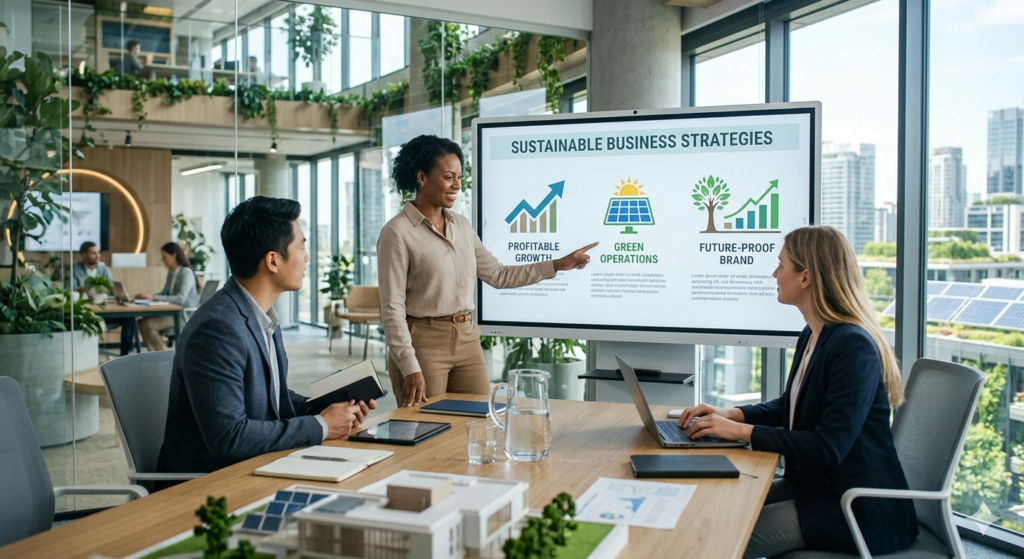
Sustainable Business Strategies: How to Build a Profitable and Future-Proof Brand
In the modern corporate ecosystem, the definition of business success has undergone a radical transformation. Gone are the days when profit margins were the sole metric of a company’s viability. Today, the intersection of profitability and ethics forms the cornerstone of enduring enterprises.
Implementing sustainable business strategies is no longer just a trend or a PR stunt; it is a fundamental economic necessity. Consumers, investors, and regulatory bodies are actively demanding transparency, environmental responsibility, and social accountability.
This comprehensive guide explores how modern enterprises can seamlessly integrate green business practices into their core operations to drive profitable business growth while safeguarding our planet.
Why Sustainability is the Ultimate Business Strategy
Many entrepreneurs mistakenly believe that adopting sustainable practices requires sacrificing profitability. However, empirical data suggests the exact opposite. Businesses that prioritize corporate sustainability consistently outperform their competitors in risk management, cost reduction, and brand loyalty.
1. Meeting the Demands of the Conscious Consumer
The modern consumer is highly educated and deeply concerned about the environment. Millennial and Gen Z demographics actively seek out brands that align with their personal values. By adopting sustainable methods, businesses unlock access to a rapidly growing, fiercely loyal market segment that is often willing to pay a premium for eco-friendly products.
2. Attracting Top Talent and Investors
Top-tier professionals want to work for companies that possess a clear purpose beyond just making money. Furthermore, venture capitalists and institutional investors are increasingly using Environmental, Social, and Governance (ESG) criteria to evaluate potential investments. If your business lacks a sustainable framework, you risk losing both talent and capital.
Key Pillars of Sustainable Business Strategies
To build a truly green and resilient business, companies must look beyond superficial changes. True sustainability requires a holistic approach that impacts every layer of the organization.
                  ┌──────────────────────────────────┐
                  │ Sustainable Business Framework   │
                  └────────────────┬─────────────────┘
                                   │
         ┌─────────────────────────┼─────────────────────────┐
         ▼                         ▼                         ▼
┌─────────────────┐       ┌─────────────────┐       ┌─────────────────┐
│  Environmental  │       │     Social      │       │   Governance    │
│   Stewardship   │       │ Equity & Impact │       │ & Transparency  │
└─────────────────┘       └─────────────────┘       └─────────────────┘
1. Environmental Stewardship
This pillar focuses on minimizing the ecological footprint of your business operations. It involves:
- Reducing greenhouse gas emissions.
- Transitioning to renewable energy sources (such as solar or wind power).
- Implementing strict waste management and recycling protocols.
2. Social Equity and Community Impact
A sustainable business must foster a positive relationship with its employees, suppliers, and the local community. This includes ensuring fair wages, safe working conditions, promoting diversity and inclusion, and giving back to community development programs.
3. Corporate Governance and Transparency
Governance refers to how a company is policed from within. Sustainable governance requires ethical leadership, accurate and transparent financial reporting, and a zero-tolerance policy for corruption and exploitation.
Step-by-Step Guide to Implementing Green Business Practices
Transitioning your company toward sustainability requires a structured roadmap. Here is an actionable framework to guide your business transition:
Step 1: Conduct a Comprehensive Sustainability Audit
Before you can change the future, you must understand your present. Measure your current energy consumption, waste production, and supply chain carbon footprint. This baseline data will help you set realistic, measurable goals.
Step 2: Optimize Your Supply Chain
Your business is only as sustainable as your weakest supplier. Partner with vendors who share your commitment to eco-friendly practices. Look for certifications like Fair Trade, LEED, or B-Corp to verify their claims.
Step 3: Embrace the Circular Economy Model
Move away from the traditional “take-make-waste” linear model. Instead, design products that are durable, repairable, and recyclable. Explore ways to reuse materials within your manufacturing process to drastically lower raw material costs.
Pro Tip for Businesses:
“The greenest product is the one that already exists. Emphasizing product longevity and repairability can open up new revenue streams through servicing and maintenance contracts.”
Financial Benefits: The ROI of Corporate Sustainability
Let’s look at the hard numbers. Green business practices directly translate into financial health. Below is a comparative look at how traditional operations stack up against sustainable practices in terms of business expenses.
| Operational Area | Traditional Approach | Sustainable Alternative | Long-Term Financial Impact |
| Energy Consumption | Reliance on fossil-fuel grids | Solar panels / LED lighting upgrades | Up to 40% reduction in monthly utility bills |
| Resource Management | High paper use & single-use packaging | Digital workflows & biodegradable packaging | Significant drop in procurement and waste disposal costs |
| Taxation & Penalties | High vulnerability to carbon taxes | Eligible for green tax credits and subsidies | Lower tax liabilities and zero regulatory fines |
| Brand Equity | Vulnerable to boycotts and PR crises | High customer retention and positive PR | Increased Customer Lifetime Value (CLV) |
Overcoming Challenges in the Transition to Sustainability
While the benefits are undeniable, businesses often face hurdles during the implementation phase. Recognizing these challenges early allows leadership to navigate them effectively.
Managing Initial Capital Expenditures (CapEx)
Switching to energy-efficient machinery or installing renewable energy infrastructure requires an upfront financial investment. To overcome this, businesses should view these expenses as long-term investments rather than short-term costs. The payback period for solar installations, for example, has drastically dropped over the past decade.
Avoiding the Pitfall of “Greenwashing”
Greenwashing occurs when a company spends more time and money marketing itself as eco-friendly than actually minimizing its environmental impact. This can lead to massive public backlash and a total loss of consumer trust.
- The Solution: Always back up your environmental claims with verifiable data, third-party certifications, and transparent annual sustainability reports.
Case Studies: Real-World Examples of Profitable Green Brands
To understand how this works in practice, let us examine two world-class companies that successfully combined profitable business growth with corporate sustainability.
Patagonia: Purpose Over Profit
The outdoor apparel giant Patagonia has built its entire brand identity around environmental activism. They famously ran an ad telling customers, “Don’t Buy This Jacket,” encouraging people to repair old gear instead of buying new items.
- The Result: This radical transparency created immense customer loyalty, propelling the company to billions of dollars in annual revenue while donating 1% of total sales to environmental groups.
IKEA: Designing for the Future
Furniture retailer IKEA has committed to becoming fully circular and climate-positive. They are heavily investing in home solar solutions, transitioning to 100% renewable energy across their stores, and offering a furniture buy-back program to prevent their products from ending up in landfills.
- The Result: IKEA proved that sustainability can be scaled globally at affordable price points, safeguarding their supply chain against future resource scarcity.
Conclusion: The Future belongs to Sustainable Enterprises
The business landscape is evolving at an unprecedented pace. The companies that thrive tomorrow will be the ones that take responsibility for their impact today. Integrating sustainable business strategies protects our planet and creates a more robust, agile, and profitable business model.
By reducing waste, optimizing resource efficiency, and genuinely connecting with conscious consumers, your brand can secure a dominant position in the marketplace. The choice is no longer between profitability and sustainability—sustainability is the path to profitability.
Frequently Asked Questions (FAQs)
What is the definition of a sustainable business strategy?
A sustainable business strategy is an operational framework where a company aims to make a positive impact on the environment, society, or both, while maintaining financial profitability and growth.
How do sustainable practices lead to business growth?
Sustainable practices drive growth by reducing long-term operational costs, building immense brand loyalty among conscious consumers, mitigating regulatory risks, and attracting ESG-focused investors.
Can small businesses afford to implement green practices?
Absolutely. Small businesses can start with low-cost, high-impact changes like moving to paperless digital invoicing, using energy-efficient smart thermostats, and sourcing inventory from local, ethical vendors.